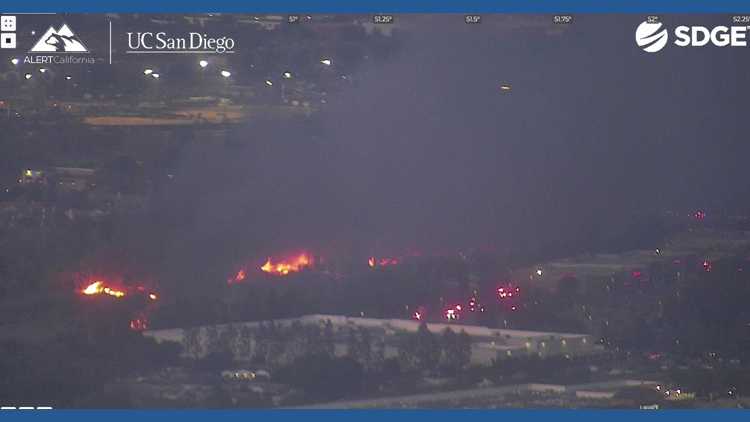
Brush Fire Sparks in Santee Riverbed
Firefighters are working to contain a 4-acre brush fire that is currently burning in a riverbed near the 100 block of Town Center Parkway in Santee, according to the Santee Fire Department. The fire was reported at 6:42 p.m. along River Walk Court near River Trail Place. It is burning in the riverbed between townhomes to the north and the Town Center Parkway Plaza to the south.
Sheriff’s deputies have evacuated shoppers from a Walmart and a Michaels craft store. However, no other residences or neighborhoods have been affected by the evacuation. Images captured by a UC San Diego/SDG&E wildfire camera show bright orange flames moving toward the south, where the shopping center is located. A firefighting helicopter has been deployed to make aerial water drops in an effort to control the fire.
As of now, there have been no reports of injuries or damage to any structures. Additionally, there has been no official information released regarding the cause of the fire. This is a developing story, and more updates will be provided as they become available.
Tips: Preparing for a Wildfire Evacuation
CalFire has created a list of essential items to have ready in case you and your family need to evacuate during a wildfire or other disaster. Ensuring that your “Go Bag” is well-stocked can make a significant difference in your safety and comfort during an emergency. Here are some key items to include:
- A 3-day supply of non-perishable food and 3 gallons of water per person
- A map with at least 2 evacuation routes
- Necessary prescriptions or medications
- A change of clothes and extra eyeglasses/contact lenses
- Extra car keys, credit cards, cash, or traveler’s checks
- A first aid kit and sanitation supplies
- A flashlight and battery-powered radio with extra batteries
- Copies of important documents (birth certificates, passports, etc.)
- Pet food and water
Always have sturdy shoes and a flashlight near your bed, ready for sudden night evacuations.
If time allows, consider adding:
- Valuables that are easy to carry
- Family photos and irreplaceable items
- Personal computer data on hard drives and disks
- Chargers for cell phones and laptops
Firefighting Terms and What They Mean
When wildfires occur across San Diego County, emergency officials often use technical terms like “containment” and “forward rate of spread” that can be confusing for residents trying to understand the threat level. CBS 8 visited Cal Fire headquarters and spoke with Cal Fire Captain Robert Johnson to explain these terms and how they affect safety during wildfire emergencies.
Contained:
Johnson explained that “contained” means the fire is surrounded by barriers—either fire lines built by crews or natural breaks like roads, lakes, and ridges. When officials report a fire is “25% contained,” it means barriers surround a quarter of the fire’s perimeter. However, Johnson warned that this does not mean the fire is 25% extinguished.
“If you have 25% containment, 50% containment, it doesn’t mean we’re out of the woods yet. It doesn’t mean we’re safe. It doesn’t mean the fire is completely extinguished, so there still are hot spots that tend to be burning within the perimeter,” Johnson said.
The forward rate of spread has been stopped:
Containment percentages can remain static while a fire continues growing, depending on whether the “forward rate of spread has stopped.”
“The fire activity has been reduced, and the fire is not actively growing in size. This does not mean the fire is contained or controlled. It just means that the predominant active side of the fire is not actively growing,” Johnson explained.
Controlled:
A “controlled” fire means 100% containment with flames extinguished and fuel cleared, though crews continue monitoring for hot spots.
“Once those hot spots are extinguished and safe, then the incident commander may say the fire is now under control,” Johnson said.
Out:
Finally, “out” means no hot spots or smoke remain.
“Once a fire has 100% containment lines around the perimeter of the fire and all the hot spots within the fire’s perimeter have been extinguished and the fire is controlled, now the fire is considered to be out,” Johnson said.
Evacuation Orders, Warnings
RED: Evacuation Order issued:
Evacuate immediately to a safe location.
YELLOW: Evacuation Warning Issued:
Potential threat to life and/or property. Those who require additional time to evacuate, and those with pets and livestock should leave now.
What factors contribute to high fire danger in Southern California?
Dry, warm Santa Ana winds
Santa Ana Winds occur when air from the desert region blows westward toward the California coast. This results in dry air that flows east to west over the mountains and towards the valleys and coast of Southern California. Santa Ana winds typically feel warm because as the cool desert air moves down the side of the mountain, it is compressed, which causes the temperature of the air to rise. We tend to see relative humidity plummet and temperatures soar during offshore wind events like this.
These winds create high fire conditions not only for a fire to start but offshore, Santa Ana winds are the perfect fan needed to allow a fire to explode in size once it starts.
Lack of rain, dry vegetation
The water year restarts every year on October 1 and measures the rain totals for the season through the following September. When rain totals are below average, the vegetation that once was green turns brown and dry and can serve as fuel for wildfires. The saturated ground can help mitigate fire risk substantially, but the opposite tends to elevate our fire risk. The sooner and more frequently we see substantial rainfall, the lower our risk of a wildfire starting and spreading rapidly.
Electrical equipment concerns
When a region is in critical fire danger, power companies tend to shut off power in pre-planned ways in order to prevent electrical equipment from sparking or starting fires. It is also because electric consumption tends to climb with warmer temperatures (usually thanks to A/C needs) and can lead to overall stress on the power grid. When you combine the risk of fire with planned power shut-offs, many school districts will close. Schools can also be used as monitoring sites for fire crews in the event of a fire starting.
