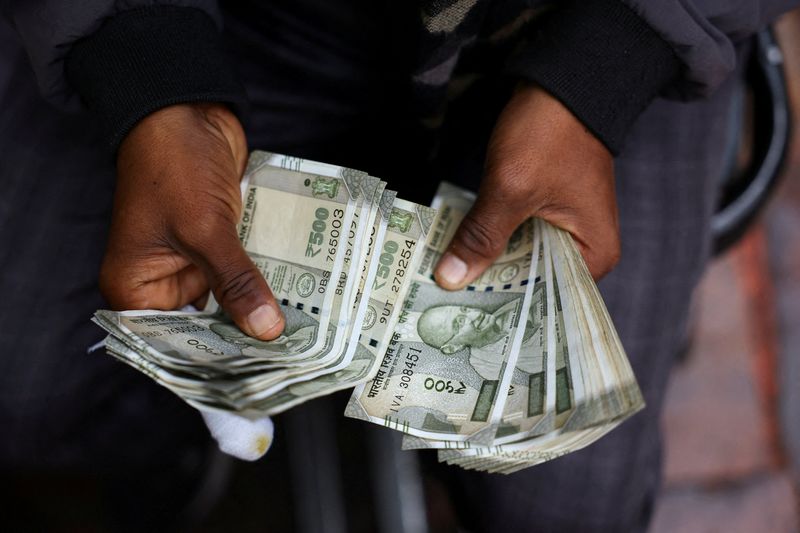
Indian Rupee Traders Brace for Turbulence as RBI Cuts FX Limits and Oil Rises Threaten Bonds
Market Volatility and Economic Pressures
Traders in the Indian foreign exchange market are preparing for a period of heightened volatility. This comes as the central bank has imposed stricter limits on lenders’ net open FX positions, adding to the uncertainty. In addition, rising oil prices are expected to continue putting pressure on government bonds.
The rupee experienced a significant decline last week, marking its fourth consecutive weekly drop of similar magnitude. It reached a record low of 94.84 against the dollar. Following market hours on Friday, the central bank announced that banks must ensure their net open rupee positions in the onshore deliverable market do not exceed $100 million at the end of each business day by April 10.
Bankers have expressed concerns that the short deadline could lead to disorderly unwinding of positions and potential losses on arbitrage positions. A trader at a state-run bank noted, “The market is likely to be volatile and with traders worried about closing arbitrage positions, one can expect that the RBI may remain active in both NDF and the onshore market.”
Impact of Rising Oil Prices
Brent crude oil futures saw a 3% increase on Monday, reaching nearly $116 per barrel as investors anticipated a prolonged conflict in the Middle East. This surge in oil prices is contributing to increased pressure on Indian government bonds.
The selloff in Indian government bonds resulted in their worst week in almost four years. The benchmark 10-year yield rose 20 basis points last week, ending at 6.9419% on Friday. This was the biggest weekly jump since May 2022, when the central bank had implemented an off-cycle rate hike.
Traders anticipate the yield to remain within a range of 6.87% to 6.95% during a week that includes just two trading sessions, including the last day of the current fiscal year. Rising oil prices and New Delhi’s decision to cut some excise duty on fuel have complicated the fiscal and growth outlook, further pressuring bonds.
The benchmark Brent crude contract has gained more than 50% in the last four weeks since the war began. Vidya Iyer, head fixed income at ICICI Prudential Life Insurance, stated, “India, as a net importer of energy and commodities, remains sensitive to these market shifts. Having proactively reduced our duration exposure several months ago, we see no immediate justification to increase it, nor do we intend to scale back further at this stage.”
Despite these challenges, there could be some relief if the government unveils plans to frontload only 51% of its gross borrowing for fiscal 2027, which amounts to 8.20 trillion rupees, compared to market expectations of 53%-56%.
Key Events to Watch
Several key events are scheduled for the upcoming week:
- India
- February industrial output: March 30, Monday (4:00 p.m. IST)
-
February fiscal deficit: March 31, Tuesday (3:30 p.m. IST)
-
March HSBC manufacturing PMI: April 2, Thursday (10:30 a.m. IST)
-
U.S.
- March consumer confidence: March 31, Tuesday (7:30 p.m. IST)
- February retail sales: April 1, Wednesday (6:00 p.m. IST)
- March S&P Global manufacturing PMI final: April 1, Wednesday (7:15 p.m. IST)
- March ISM manufacturing PMI: April 1, Wednesday (7:30 p.m. IST)
- February international trade: April 2, Thursday (6:00 p.m. IST)
- Initial weekly jobless claims for week to March 28: April 2, Thursday (6:00 p.m. IST)
- March non-farm payroll and unemployment rate: April 3, Friday (6:00 p.m. IST)
- March S&P Global composite PMI final: April 3, Friday (7:15 p.m. IST)
- March S&P Global services PMI final: April 3, Friday (7:15 p.m. IST)
Overnight index swap rates have surged by 55-69 bps in the last four weeks, and even though the derivative asset class is factoring in more than two rate hikes, analysts suggest the market is overestimating the impact of the Iran war on domestic monetary policy.
