7 in 10 Foreigners Favor K-Pop and the Korean Wave
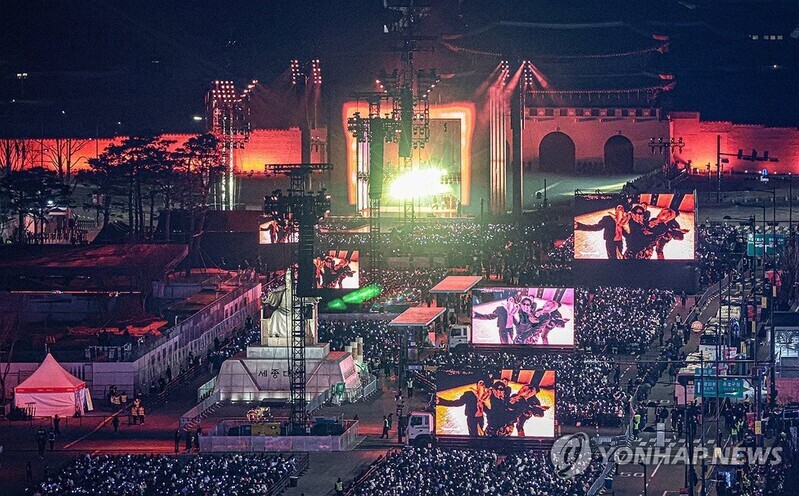
▲ BTS performs at Seoul’s Gwanghwamun Square during a concert marking the live debut of the group’s fifth studio album
A recent survey has revealed that the Korean Wave, or Hallyu, continues to capture the hearts of people around the world. According to a government report titled “2026 Overseas Hallyu Survey” (based on 2025 data), approximately 69.7% of 27,400 respondents across 30 countries who had engaged with Korean cultural content expressed positive views. This indicates a strong and growing appreciation for South Korea’s cultural exports.
Regional Trends in Hallyu Perception
Southeast Asia remains a stronghold for Hallyu, with the Philippines leading the way at 87.0%, followed closely by India (83.8%), Indonesia (82.7%), and Thailand (79.4%). Western countries have also seen significant improvements, with notable increases in favorability in the United Kingdom (+8.0 percentage points), Spain (+6.2 points), the United States (+6.1 points), and Australia (+6.0 points). Japan also recorded a 6.4-point increase compared to the previous year.
Popular Hallyu Categories
When it comes to specific forms of Hallyu, Korean food emerged as the most popular category, with 55.1% of respondents citing it as their favorite. Music followed closely at 54.0%, while beauty (52.6%), dramas (51.3%), and films (48.9%) rounded out the top five.
In terms of consumption experience, food topped the list at 78.0%, followed by films (77.9%), dramas (72.9%), music (71.9%), and beauty (61.8%).
K-pop Dominance
K-pop maintained its position as the top image associated with South Korea for the ninth consecutive year, with 17.5% of respondents linking it to the country. Korean food came in second at 12.1%, followed by dramas (9.5%), beauty (6.2%), and films (5.9%).
Interestingly, negative perceptions such as the Korean War and North Korea-related security risks fell out of the top 10, signaling a shift in global attitudes from security concerns to cultural appeal.
Hybrid Content and New Trends
For the first time, the survey explored perceptions of hybrid content that blends Korean culture with foreign production. The Netflix series “K-Pop Demon Hunters” was one such example. Respondents highlighted the inclusion of Korean cultural elements (23.3%) as the most important factor in recognizing such content as Korean, followed by the presence of many Korean characters (21.8%) and Korean settings (19.1%).
These hybrid productions received largely positive feedback, with 60.0% of respondents describing them as “attractive” and “trendy.” Additionally, 57.3% found them “easy to accept,” and 55.0% considered them “original.”
Top Hallyu Titles and Stars
In the drama category, Netflix’s “Squid Game” continued its dominance, ranking first for the fifth consecutive year with 12.4%. Other notable entries included “When Life Gives You Tangerines” (4.6%) and “The Tyrant’s Chef” (2.1%).
In the film category, Bong Joon-ho’s “Parasite” remained the top choice for the sixth year in a row with 8.4%, followed by Yeon Sang-ho’s “Train to Busan” at 5.8%. Newly released films, however, saw relatively lower preference.
BTS retained its position as the most popular singer for the eighth consecutive year, securing 21.9% of the votes. BLACKPINK followed in second place with 12.6%, while actor Lee Min-ho claimed the top spot in the Hallyu star category for the 13th year in a row with 7.1%.
Consumer Behavior and Spending
On average, consumers spent 14.7 hours per month engaging with Korean cultural content, with spending per category reaching $16.6. Dramas led in consumption time at 18.3 hours, while entertainment shows (17.7 hours) and games (16.8 hours) followed closely.
Spending patterns showed fashion ($33.9), beauty ($29.7), and food ($24.9) as the highest categories.
Positive Impact and Challenges
Sixty-four point eight percent of respondents reported that Hallyu had a positive impact on their purchases of Korean products and services, marking a third consecutive year of growth. Key purchasing factors included quality (61.8%), price (43.0%), and ease of use (33.4%).
Despite this, 37.5% of respondents still held negative perceptions of Hallyu. The main reasons cited were excessive commercialization (16.1%), geopolitical risks related to the Korean Peninsula (12.9%), inappropriate behavior by Hallyu stars (11.5%), and the need to protect domestic content industries (11.3%).
Future Plans for Hallyu Expansion
The Ministry of Culture, Sports and Tourism plans to leverage these findings to strengthen the foundation of the K-culture industry. It aims to support the global expansion of Hallyu through initiatives such as the “K-Expo” in countries like the United States, France, and Mexico, as well as expanding overseas promotional centers “Korea 360” to regions including the United States and Vietnam.
